
What Is Vibe Coding? A Guide for Business Teams
Vibe coding lets non-technical Singapore teams build working apps and internal tools using plain language and AI — no developer required. This guide covers what it is, what teams are


Your sales reps are spending more than half their day on manual prospecting — researching contacts, writing cold emails, updating CRMs, and chasing unqualified leads. Meanwhile, your competitors are deploying AI outbound sales tools that do much of that work in minutes. If you lead a B2B sales team in Singapore, this gap is no longer theoretical. It is the single biggest threat to your pipeline velocity right now.
AI outbound sales in Singapore is not a futuristic concept. It is happening today, across mid-market and enterprise organisations that have decided to stop treating outbound prospecting like a numbers game and start treating it like a strategic advantage. The question is no longer whether your team should adopt AI-powered outbound tools — it is how quickly and how smartly you can do it.
This guide walks you through the problem, the opportunity, and a practical implementation framework designed specifically for Singapore and Southeast Asian sales organisations.
Let’s be honest about the state of B2B outbound sales in most Singapore organisations. Your SDRs are manually combing through LinkedIn, building prospect lists in spreadsheets, and sending generic cold emails that get ignored. Conversion rates are declining. Your team is burning out. And the cost per qualified meeting keeps climbing.
This is not a motivation problem. It is a systems problem.
Traditional outbound relies on volume — more calls, more emails, more activity. But buyers in Southeast Asia are overwhelmed with outreach. Decision-makers in Singapore receive dozens of cold emails daily, and they have become expert at ignoring anything that feels templated or irrelevant. The old playbook of “spray and pray” outbound is producing diminishing returns, and no amount of effort from your reps can fix a fundamentally broken approach.
Here is what makes this problem urgent. According to Salesforce’s State of Sales report (6th edition, 2023), high-performing sales teams are 4.9 times more likely to be using AI than underperforming teams. AI adoption is now the single largest differentiator between top and bottom quartile sales organisations globally.
That gap is widening every quarter. If your competitors in Singapore and the broader ASEAN region are adopting AI sales prospecting tools while your team relies on manual processes, you are not standing still — you are falling behind.
Singapore ranks among the top three most AI-ready nations in Asia Pacific, according to the 2023 Government AI Readiness Index by Oxford Insights. The infrastructure, talent pool, regulatory environment, and government support are all in place. For sales leaders, this means the barriers to adopting B2B outbound sales automation in Singapore are lower here than almost anywhere else in the region.
Gartner predicts that by 2025, 75% of B2B sales organisations will augment their traditional sales playbooks with AI-guided selling solutions — up from less than 25% in 2022. Meanwhile, LinkedIn’s 2023 State of Sales Report found that 62% of salespeople in Asia Pacific who exceeded quota used AI or automation tools for at least part of their outbound prospecting workflow. That is a 15-percentage-point jump from the previous year.
On the operational side, McKinsey’s B2B Pulse Survey found that AI-powered outbound sales tools — including intent data platforms, AI SDR bots, and personalisation engines — can reduce prospecting time by up to 40% and increase meeting conversion rates by 20–30%.
These are not marginal improvements. They represent a fundamental shift in how pipeline is built.
What most US-centric AI sales content ignores is that Singapore offers unique advantages for adoption. IMDA’s SMEs Go Digital programme and the AI Adopt initiative provide co-funding for AI capability-building, including sales technology stacks. If you are a mid-market or enterprise organisation, there is government support available to offset your investment in AI cold outreach tools.
Sales engagement platforms like Apollo.io, Outreach, Salesloft, and Clay are seeing regional user bases grow by an estimated 35–50% year-over-year as of 2023–2024, according to G2 Market Reports. The ecosystem is maturing rapidly, and early movers in Singapore are already building a competitive moat.
Here is where most sales leaders get stuck. They know AI sales tools exist. They may have even trialled one or two. But adoption stalls because there is no clear implementation roadmap — and no strategy for integrating AI into existing workflows without disrupting what already works.
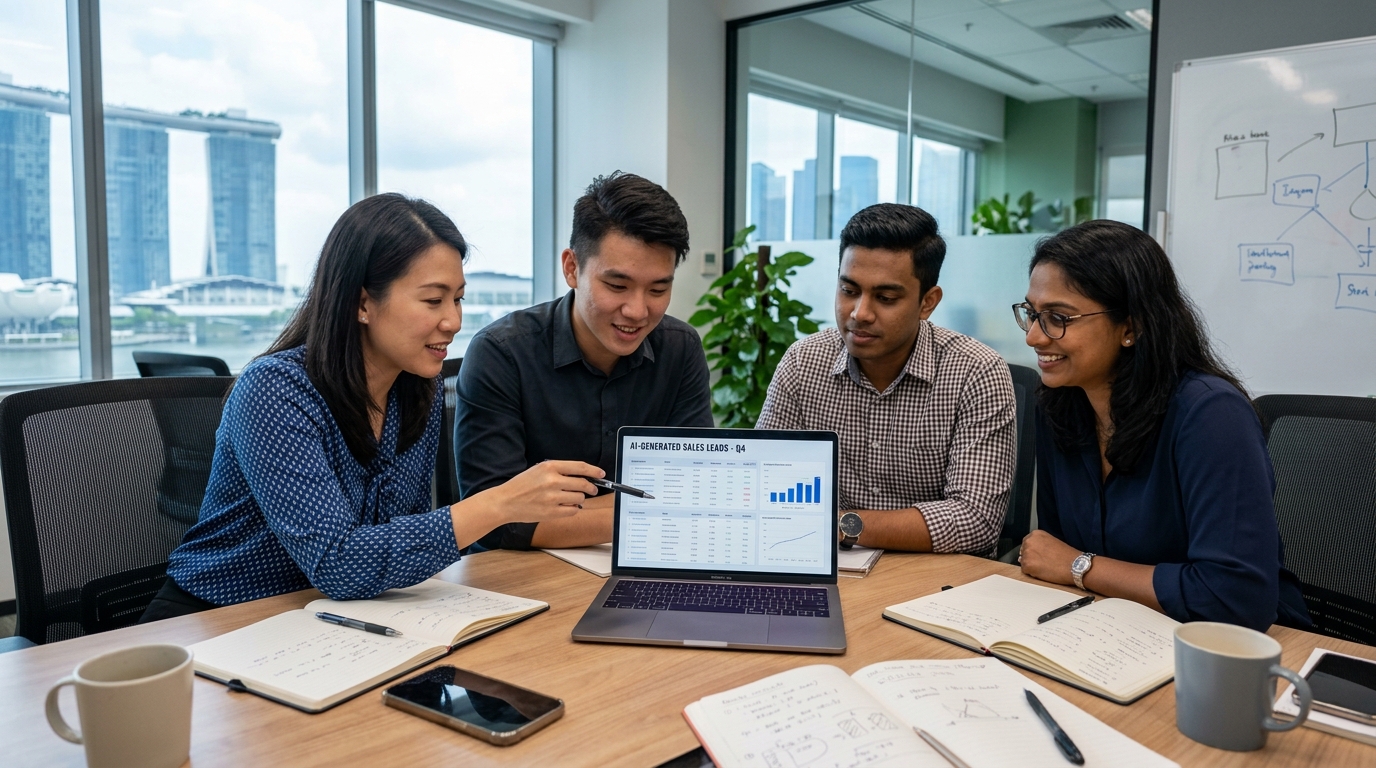
Below is a four-stage framework designed for Singapore B2B sales teams.
Before you buy any tool, map your current outbound process end-to-end. Identify where your reps spend the most time on low-value, repetitive tasks — prospect list building, email personalisation, follow-up sequencing, data entry. These are your highest-impact automation targets.
Ask your team directly: “What takes the most time but adds the least value?” The answers will guide your tool selection far better than any vendor demo.
Do not try to automate everything at once. Choose one or two AI-powered tools that address your most painful bottlenecks. For most Singapore sales teams, the highest-ROI starting points are:
One critical consideration for Singapore teams: ensure any tool you select is compliant with the Personal Data Protection Act (PDPA). This means verifying how prospect data is sourced, stored, and used — and confirming that your outreach sequences include proper consent and opt-out mechanisms.
This is the most important stage, and it is where many organisations get it wrong. AI outbound sales tools are force multipliers, not replacements. The technology handles the heavy lifting of research, personalisation, and sequencing. Your reps bring the relationship-building, consultative selling, and deal-closing skills that Southeast Asian buyers expect.
In fact, AI can make your reps significantly more effective in conversations. For example, AI tools can surface common objections during outbound sequences, helping your team prepare personalised responses before calls or meetings. Pairing this data with strong sales objection handling techniques for B2B teams gives your reps a measurable edge in live interactions.
The best-performing teams invest equally in technology and human capability. That means pairing AI tool adoption with structured B2B sales training programmes in Singapore that teach reps how to interpret AI-generated insights, lead consultative conversations, and close deals that AI surfaces but cannot finish.
Set clear KPIs before you launch. Track metrics like prospecting time per qualified lead, email reply rates, meeting conversion rates, and pipeline velocity. Compare these against your pre-AI baseline.
Review performance monthly for the first quarter. AI tools improve with better data, so expect results to compound over time. Once you have validated the approach with one team or segment, scale it across your organisation.
Technology alone does not transform sales performance. Your reps need to understand how to work alongside AI — interpreting intent signals, prioritising AI-scored leads, and engaging prospects with the contextual intelligence that automation provides.
This is especially true for enterprise sales teams managing complex, multi-stakeholder deals across Southeast Asia. The multicultural nuances of selling across Singapore, Malaysia, Indonesia, Thailand, and the Philippines demand human judgement that no algorithm can replicate. AI handles the data; your reps handle the relationships.
Investing in enterprise sales training workshops that specifically address AI-augmented selling workflows ensures your team captures the full value of your technology investment. Without this training layer, even the best sales AI tools in Southeast Asia will underperform.
The window for early-mover advantage in AI outbound sales in Singapore is closing. As adoption accelerates across the region, the organisations that combine smart AI tooling with skilled, well-trained sales teams will dominate their markets. Those that wait will find themselves competing on volume in a game that volume can no longer win.
You do not need to overhaul your entire sales operation overnight. Start with a focused pilot, invest in the right tools and the right training, and build from there. The technology is ready. The government support is available. Your competitors are already moving.
The only question is whether your team will lead or follow.
Ready to equip your sales team for the AI-powered outbound era? Book a consultation with our sales training specialists to learn how we help Singapore sales organisations blend AI tools with world-class selling skills so your team closes more deals, faster.
Vibe coding lets non-technical Singapore teams build working apps and internal tools using plain language and AI — no developer required. This guide covers what it is, what teams are

Addestra’s free AI prompting webinar in Singapore — Beyond Basic AI Prompting — teaches working professionals structured prompting frameworks, hallucination reduction strategies, and reusable prompt templates in a live 90-minute

A role-by-role buyer’s guide helping L&D managers and business owners match the right generative AI course in Singapore to each department — from marketing and design to operations, data, and

No-code AI automation is helping Singapore admin and ops teams move beyond rigid rule-based tools—enabling non-technical staff to build workflows that read, classify, and act on information without a single