
What Is Vibe Coding? A Guide for Business Teams
Vibe coding lets non-technical Singapore teams build working apps and internal tools using plain language and AI — no developer required. This guide covers what it is, what teams are

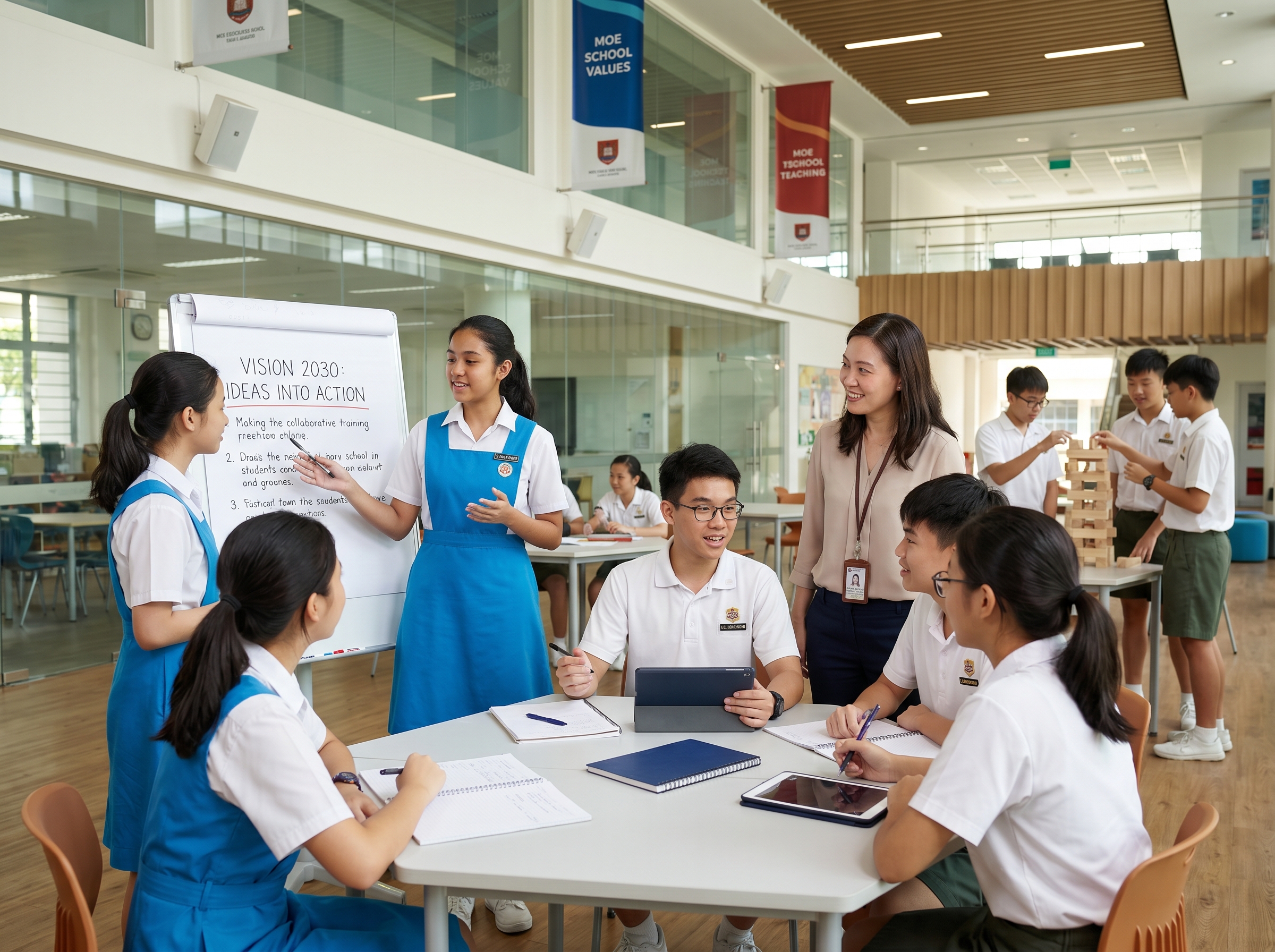
A Secondary 3 student council president freezes mid-sentence during a school assembly address. A primary school prefect struggles to mediate a playground dispute between classmates. A CCA leader can’t delegate tasks and ends up doing everything alone, burning out by Term 2.
These are the gaps that surface when student leadership training in Singapore is treated as a title exercise rather than a structured skillset — and they’re more common than most educators would like to admit. Schools appoint student leaders every year. But appointing a leader and developing one are fundamentally different things.
If you’re a principal, HOD, or teacher-in-charge responsible for your school’s student leadership development, this article is for you. We’ll break down why structured programmes matter, what separates effective training from checkbox activities, and how to evaluate providers who can deliver real outcomes for your students.
Most Singapore schools have a student leadership structure in place. Prefects, class monitors, CCA captains, student councillors — the roles exist. What’s often missing is the development pipeline behind them.
Here’s what typically happens. A student gets selected based on academic performance or teacher recommendation. They receive a badge, a brief orientation, maybe a one-day camp. Then they’re expected to lead, to resolve conflicts, manage peers, speak publicly, and model behaviour with little to no formal training in any of those skills.
The result? Students who hold leadership titles but lack leadership competencies. They default to authoritarian behaviour because they haven’t learned collaborative approaches. They avoid difficult conversations because no one has taught them how to navigate them. They lose confidence after early stumbles because they have no framework for reflection and growth.
This isn’t a failure of the students. It’s a gap in the system and it’s one that structured student leadership training programmes are specifically designed to close.

This isn’t just a nice-to-have. Singapore’s Ministry of Education has embedded student leadership development as a core pillar of the Character and Citizenship Education (CCE) framework, expecting schools to provide structured opportunities for students to develop leadership competencies beyond academic achievement.
MOE’s Student Leadership Development framework goes further. It recognises multiple tiers of student leaders from class monitors and CCA leaders to student councillors and prefects — and calls on schools to provide progressive, structured development for each tier. The expectation is clear: leadership development should be intentional and scaffolded, not left to informal on-the-job learning.
Singapore’s 21st Century Competencies (21CC) framework, which guides all MOE schools, explicitly lists critical and inventive thinking, communication, collaboration, and civic literacy as key outcomes. Student leadership programmes are uniquely positioned to develop all of these but only when they’re designed with intentionality rather than treated as ad hoc enrichment.
The frameworks are there. The question is whether your school’s current approach actually fulfils them.
Not all leadership programmes deliver equal value. A one-off motivational talk might energise students for a week. A structured, skills-based programme changes how they lead for years.
The widely cited 70-20-10 learning model from the Center for Creative Leadership applies directly to student leadership development. Roughly 70% of leadership growth comes from experiential practice, 20% from working with peers and mentors, and only 10% from formal instruction. Any programme that’s mostly lecture-based is missing the majority of how students actually learn to lead.
Effective programmes incorporate role-play scenarios, team challenges, peer feedback loops, and real-world simulations. Students practise making decisions under pressure, giving constructive feedback, and managing group dynamics — not just hearing about these things in a classroom.
Your school’s leadership structure, student profile, and development goals are different from the school down the road. A secondary school with a strong prefectorial board needs different training from a primary school developing its first cohort of peer leaders.
This is why one-size-fits-all programmes often fall flat. The best providers take time to understand your school’s context your existing leadership tiers, the competencies you want to build, and the real challenges your student leaders face then design the programme around those specifics. At Addestra, this is how we approach every school engagement. Just as we build customised training around your school’s goals, our school programmes are tailored to each institution’s unique needs and student profile.
Leadership and communication are inseparable. A student who can think strategically but can’t articulate a vision to peers will struggle to lead effectively. A prefect who can’t manage a difficult conversation with a classmate will avoid confrontation altogether.
That’s why the strongest student leadership programmes integrate communication skills — active listening, assertive speaking, conflict resolution dialogue, and public presentation — as foundational elements rather than optional add-ons. Schools looking to deepen this further often complement leadership training with dedicated oracy and communication programmes for Singapore schools or debate and public speaking programmes for Singapore schools to build a more complete student development ecosystem.
With over 350 primary schools and over 150 secondary schools across Singapore, according to MOE’s Education Statistics Digest 2024, the demand for quality enrichment and leadership providers is substantial. But not every provider is equipped to deliver meaningful outcomes. Here’s what to look for.
Ask how long the provider has been working with Singapore schools — and how many students they’ve trained. Experience matters because it means the provider understands MOE’s expectations, school scheduling constraints, and the nuances of working with different age groups. Addestra Learning Centre has been operating since 2006, with nearly 20 years of experience and over 30,000 students trained across MOE primary schools, secondary schools, junior colleges, and teacher development programmes.
Ask whether the programme will be designed specifically for your school or pulled from a standard template. Probe into their process: Will they conduct a needs assessment? Will they consult with your HOD or teacher-in-charge before designing the programme? Will the content reflect your school’s values and leadership structure?
A provider who asks detailed questions about your school before proposing a programme is far more likely to deliver relevant outcomes than one who sends a fixed brochure.
Ask about the training methodology. What percentage of the programme is activity-based versus lecture-based? Do facilitators use role-play, case studies, group challenges, and reflection exercises? Are students given opportunities to practise skills in real-time, receive feedback, and iterate?
If the programme description reads like a series of talks, it’s unlikely to produce lasting leadership growth.
The facilitator makes or breaks the programme. Ask about their background: Do they have experience working with young people? Can they manage a room of energetic Primary 5 students and a group of JC1 student councillors? Are they trained in facilitation techniques, not just subject-matter expertise?
Experienced facilitators adapt in real time. They read the room, adjust the pace, and connect with students in ways that make the learning stick.
A provider with a broader portfolio — not just leadership, but communication, enrichment, and CCA-aligned programmes — often brings a more holistic understanding of student development. As a school enrichment and CCA programme provider in Singapore, Addestra delivers programmes across multiple domains, which means our facilitators understand how leadership training connects to the wider student development journey your school is building.
If you’re an HOD or teacher-in-charge who sees the value in structured student leadership training in Singapore but needs to get buy-in from your school leadership team, here’s how to frame it.
It addresses MOE’s frameworks directly. Structured leadership programmes are not extracurricular luxuries — they’re aligned with CCE, 21CC, and MOE’s tiered student leadership expectations. Investing in them demonstrates your school’s commitment to holistic education.
It reduces the burden on teachers. When student leaders are properly trained, they’re more effective in their roles. They manage peers better, require less direct supervision, and contribute more meaningfully to school culture. That translates to less firefighting for teacher-mentors.
It builds skills that matter beyond school. Research published in the Journal of Leadership Education consistently shows that students who participate in structured leadership programmes demonstrate stronger communication skills, higher self-efficacy, and greater readiness for future workplace demands. You’re not just developing better prefects — you’re preparing students for life after school.
It creates a self-sustaining leadership culture. When each cohort of student leaders is properly developed, they model effective leadership for the next cohort. Over time, your school builds a leadership culture that reinforces itself — reducing the need to start from scratch every year.
Student leadership training in Singapore doesn’t need to be complicated, but it does need to be intentional. The schools that get this right don’t leave leadership development to chance. They invest in structured, customised programmes led by experienced facilitators and they see the results in more confident, capable student leaders who genuinely make a difference in their school communities.
Addestra Learning Centre has been partnering with MOE schools for nearly two decades, delivering leadership and enrichment programmes that are designed around each school’s unique context and goals. If you’re looking for a student leadership programme provider who understands Singapore schools from the inside, we’d welcome the conversation.
Contact us to discuss a student leadership programme for your school
Vibe coding lets non-technical Singapore teams build working apps and internal tools using plain language and AI — no developer required. This guide covers what it is, what teams are

Addestra’s free AI prompting webinar in Singapore — Beyond Basic AI Prompting — teaches working professionals structured prompting frameworks, hallucination reduction strategies, and reusable prompt templates in a live 90-minute

A role-by-role buyer’s guide helping L&D managers and business owners match the right generative AI course in Singapore to each department — from marketing and design to operations, data, and

No-code AI automation is helping Singapore admin and ops teams move beyond rigid rule-based tools—enabling non-technical staff to build workflows that read, classify, and act on information without a single