

What Is Vibe Coding? A Guide for Business Teams
Vibe coding lets non-technical Singapore teams build working apps and internal tools using plain language and AI — no developer required. This guide covers what it is, what teams are
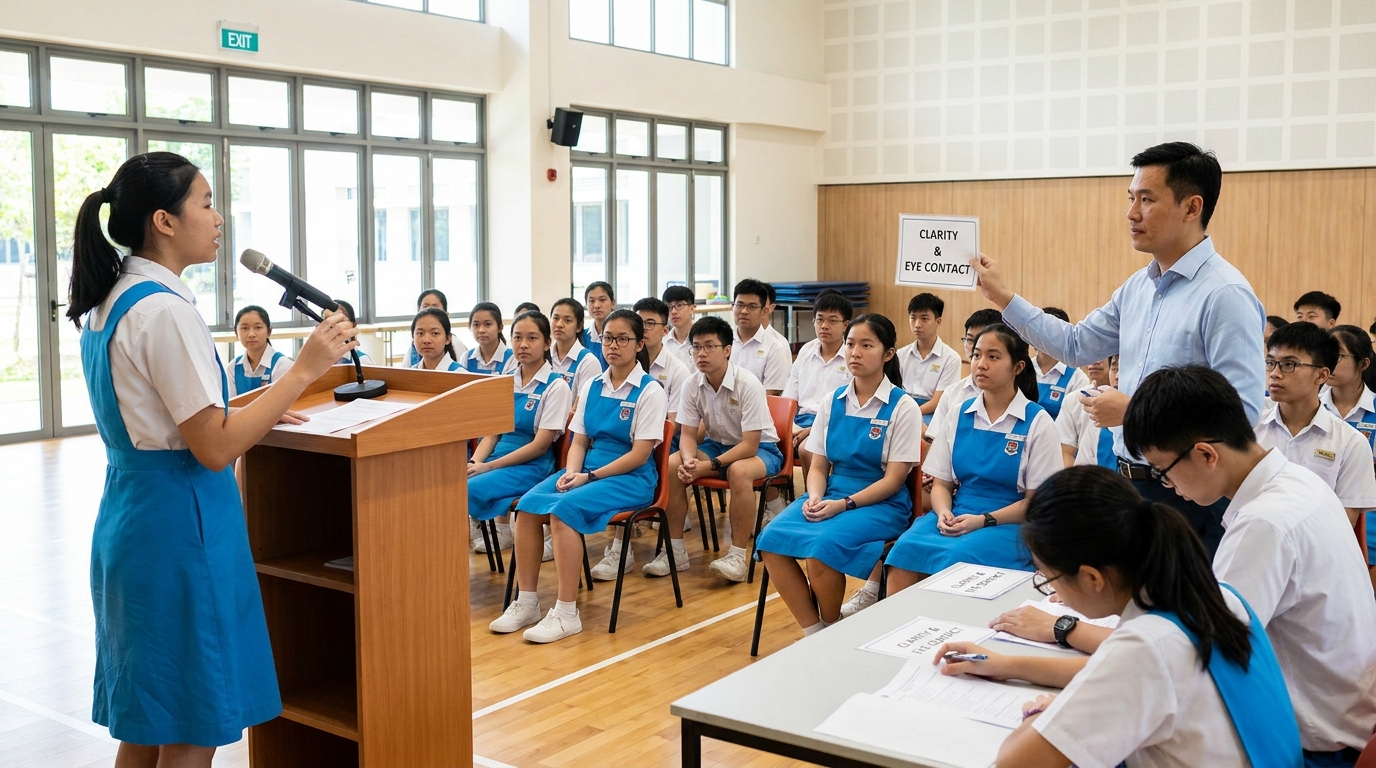
Three proposals land on your desk. Each promises to “build confident communicators.” Each comes with a glossy programme outline and a list of satisfied schools. Yet the actual workshop experiences they deliver couldn’t be more different and the wrong choice means lost curriculum time, disengaged students, and a programme that looks good on paper but changes nothing in practice.
Choosing a public speaking workshop for students in Singapore is one of the more consequential enrichment decisions an HOD or teacher-in-charge will make. Oracy sits at the centre of MOE’s 21st Century Competencies framework, which identifies communication, collaboration, and information skills as core competencies across all levels. With that policy context in mind, the stakes for getting this right are real.
This guide walks you through the practical criteria that matter so you can evaluate providers with confidence and select a public speaking workshop Singapore schools will genuinely benefit from.
A rigorous evaluation protects your students, your budget, and your credibility as a decision-maker — because public speaking workshops vary far more in quality and approach than their marketing materials suggest.
It’s tempting to shortlist based on price, availability, or a colleague’s recommendation. Those factors matter, but they shouldn’t drive the decision alone.
Public speaking workshops vary enormously in pedagogy, depth, and facilitator quality. Some programmes give students unstructured speaking time and call it “practice.” Others follow a carefully scaffolded approach — moving learners through voice projection, eye contact, body language, content organisation, and audience awareness in deliberate stages. The difference in student outcomes is significant.
When a programme doesn’t match your students’ developmental level or your school’s objectives, the consequences go beyond a wasted afternoon. Students who have a negative early experience with public speaking can become more anxious, not less. Teachers lose faith in enrichment programmes generally. And the budget you allocated for meaningful development yields little to show at the next HOD review.
The growing emphasis on oracy programmes in Singapore schools means you’ll likely be making this decision more than once. Having a clear evaluation framework saves time and protects your students’ learning experience.
The right format depends on your school’s objectives and constraints — enrichment modules, CCA training, ALP integration, and Student Development initiatives each require a meaningfully different programme design.
Before comparing providers, clarify what delivery format suits your school’s context. In Singapore’s school landscape, public speaking workshops are typically delivered as enrichment modules, CCA training sessions, Applied Learning Programme (ALP) components, or Student Development team-building initiatives — each requiring different programme design, as outlined in MOE’s CCA and Student Development frameworks.
These are usually one-off or short-series sessions delivered during curriculum time or post-exam periods. They work well for broad exposure — introducing an entire cohort to presentation skills or preparing students for specific events like project showcases.
For enrichment modules, look for providers who can adapt session length and content to your timetable. A programme designed for a 3-hour block won’t translate well into three separate 1-hour slots without intentional redesign.
If you’re running a debate or public speaking CCA, you need something deeper. CCA programmes should follow a progressive syllabus across a semester or full year, with skill-building that compounds over time.
This is where providers offering debate and public speaking programmes for Singapore schools become relevant. Ask whether their CCA track includes competitive preparation, performance benchmarks, and regular feedback cycles — not just weekly standalone sessions.
Some schools embed public speaking within broader Applied Learning Programmes or Student Development initiatives. In these cases, the workshop needs to align tightly with your school’s ALP theme or character education goals.
For instance, schools that run leadership-focused ALPs often pair public speaking training with student leadership training in Singapore to develop prefects or student councillors who can speak with clarity and authority. If that’s your context, look for a provider who understands the intersection — not one offering a generic module they slot into any frame.
Pedagogy and facilitation quality are where strong providers separate themselves — a well-designed curriculum only delivers results when the person in the room can execute it effectively with your students.
Programme format is the “what.” Pedagogy is the “how” — and it’s where quality providers separate themselves.
Research on oracy pedagogy, including the work of Robin Alexander at Cambridge, consistently points to structured scaffolding as the foundation of effective public speaking instruction. Students need to progress through defined stages — from basic vocal control to sophisticated audience engagement — with each skill practised, modelled, and reinforced before moving on.
Ask providers directly: What does your progression model look like? If they can’t articulate one, that’s a meaningful signal.
A strong curriculum means little if the person delivering it can’t command a classroom of Secondary 2 students at 2pm on a Friday. Facilitation quality is often the single biggest variable in programme effectiveness.
Here are the questions worth asking:
Experienced providers will welcome these questions. At Addestra, we’ve spent over 15 years training tens of thousands of learners — and a core lesson from that experience is that facilitator quality is non-negotiable.
One practical metric to ask about: how many students actually speak during a session? A two-hour workshop for 40 students where only 8 present is largely a spectator experience for three-quarters of the room.
Strong programmes build in pair work, small-group exercises, and structured peer feedback so every student gets meaningful speaking time. This is especially important for students who are naturally quieter — they need safe, scaffolded opportunities, not a single high-pressure moment in front of the whole cohort.
Schools need public speaking programmes that reinforce MOE’s oracy objectives and produce outcomes specific enough to assess and report — not vague promises of increased confidence.
The MOE English Language Syllabus treats oracy as a distinct learning domain alongside reading, writing, and grammar. Spoken interaction and presentation skills are formally assessed at PSLE and O-Level. A public speaking workshop for students in Singapore should reinforce — not duplicate or contradict — what students are already learning in the classroom.
When evaluating providers, ask how their programme maps to MOE’s oracy outcomes. This is particularly important for primary school enrichment, where sessions should complement rather than confuse what the English teacher is building throughout the term.
Before you sign the purchase order, get clear on outcomes. What will be different after this programme? Vague promises like “students will become more confident” aren’t enough.
Look for providers who can articulate specific, observable outcomes:
These outcomes give you something concrete to assess — and something meaningful to report upward.
The clearest warning signs are one-size-fits-all proposals, no pre-programme consultation, and a track record built primarily outside the school context.
Not every provider who markets a public speaking programme Singapore schools can trust will deliver genuine value. Here are warning signs to take seriously.
If a provider sends you the exact same programme outline they’d send to any school, without asking about your students’ level, your school’s priorities, or your delivery constraints — proceed with caution. Effective programmes require contextualisation.
A provider who doesn’t want to speak with you before confirming the programme is likely running a template. Pre-programme conversations are where a good provider learns about your cohort size, student profile, learning objectives, and logistical requirements. That conversation should feel collaborative, not transactional.
Beware of workshops built entirely around a showcase or final performance with minimal skill-building leading up to it. These can create impressive-looking outcomes for a handful of naturally confident students while leaving anxious or reluctant speakers behind. The process of learning to speak well is where the real development happens.
Public speaking coaching for adults and public speaking facilitation for students are fundamentally different skills. A provider with extensive corporate experience but limited school experience may struggle with age-appropriate pedagogy, classroom dynamics, and the specific expectations of an MOE school environment.
When reviewing school enrichment programme providers in Singapore, prioritise those with a demonstrated history in the school context — not providers who’ve recently pivoted from a different market.
Choosing a public speaking workshop Singapore students will genuinely learn from comes down to asking the right questions and knowing what good answers sound like. Format, pedagogy, facilitator quality, MOE alignment, and measurable outcomes — these are the pillars of a sound evaluation.
You don’t need to become an expert in oracy education to make this call well. You simply need a clear framework and a provider willing to meet you where your school’s needs are.
At Addestra, we’ve partnered with MOE schools across Singapore for over a decade, delivering public speaking and oracy programmes tailored to each school’s unique context — from primary school enrichment modules to secondary school CCA training and leadership development integration.
Q: How much does a public speaking workshop for students in Singapore typically cost?
Pricing varies widely depending on programme length, cohort size, and provider experience. Short enrichment modules for a single cohort are generally more affordable, while semester-long CCA programmes or ALP-integrated tracks carry higher fees. Always request a detailed quote and compare what is included — facilitator credentials, materials, and pre-programme consultation — not just the headline price.
Q: How do I know if a public speaking programme aligns with MOE requirements?
Ask the provider directly how their programme maps to MOE’s English Language Syllabus oracy outcomes, which formally cover spoken interaction and presentation skills from primary through secondary levels. A credible provider should be able to show you a clear curriculum mapping, particularly if the workshop is intended to complement classroom English instruction.
Q: What is a realistic student-to-facilitator ratio for an effective workshop?
A ratio that allows every student meaningful speaking time is the benchmark to aim for. In practice, this means watching out for workshops where only a fraction of the cohort actually presents — a two-hour session for 40 students where just 8 speak is largely passive for the rest. Strong programmes use pair work, small-group exercises, and structured peer feedback to maximise active participation.
Q: How long does it take to see measurable improvement in students’ public speaking skills?
Even a well-designed single-day enrichment module can produce observable improvements in specific skills such as structure, eye contact, and vocal projection. Deeper and more lasting development — particularly for anxious or reluctant speakers — typically requires a progressive programme delivered across a semester or full year with compounding skill-building.
If you’re exploring options for your school, we’d welcome the conversation. Contact us to discuss a programme that fits your students, your timetable, and your development goals. Or explore our full range of school programmes to see where public speaking training fits within a broader enrichment plan.
Vibe coding lets non-technical Singapore teams build working apps and internal tools using plain language and AI — no developer required. This guide covers what it is, what teams are

Addestra’s free AI prompting webinar in Singapore — Beyond Basic AI Prompting — teaches working professionals structured prompting frameworks, hallucination reduction strategies, and reusable prompt templates in a live 90-minute

A role-by-role buyer’s guide helping L&D managers and business owners match the right generative AI course in Singapore to each department — from marketing and design to operations, data, and

No-code AI automation is helping Singapore admin and ops teams move beyond rigid rule-based tools—enabling non-technical staff to build workflows that read, classify, and act on information without a single
Secure your place for the workshop — fill in your details below.