

What Is Vibe Coding? A Guide for Business Teams
Vibe coding lets non-technical Singapore teams build working apps and internal tools using plain language and AI — no developer required. This guide covers what it is, what teams are
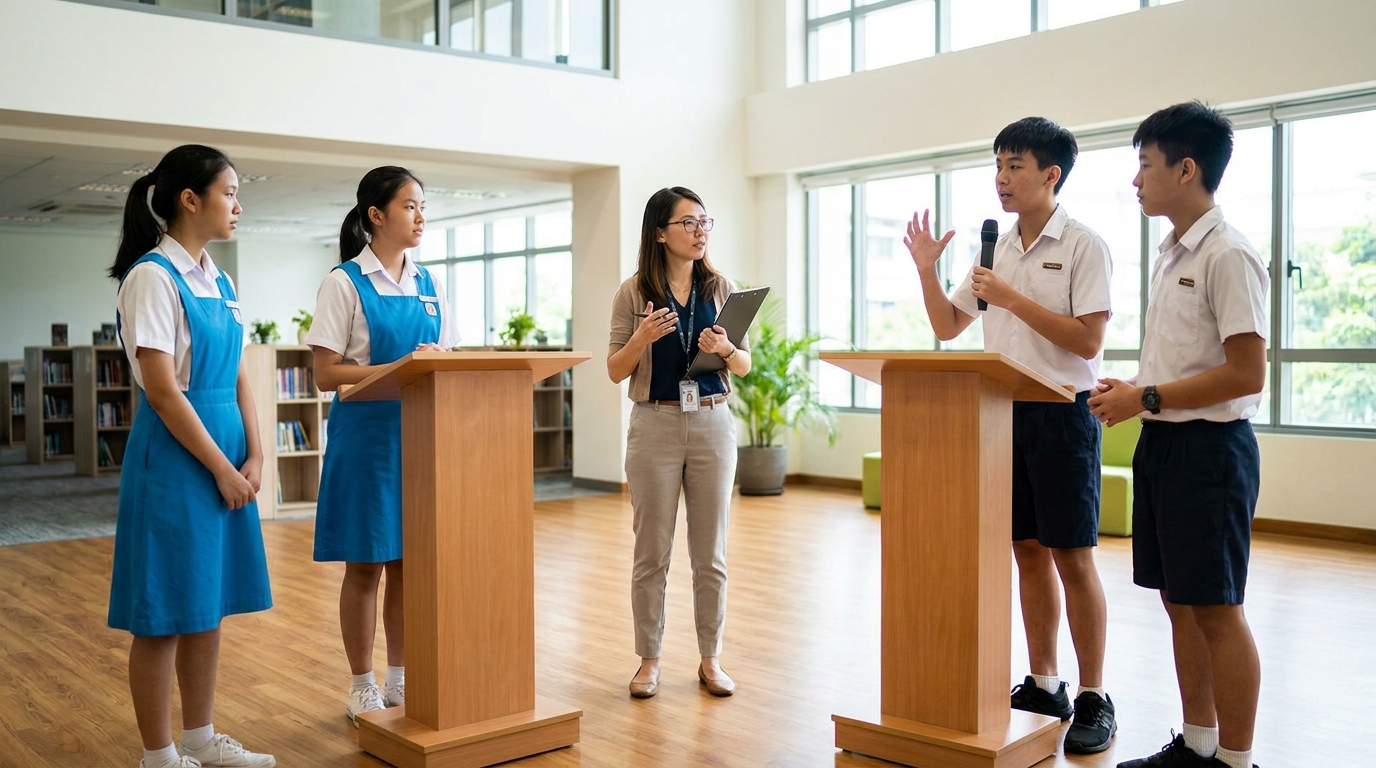
A Primary 4 student stands up, takes a breath, and says: “I disagree, and here’s why.” That moment — where a student moves from having an opinion to defending one — is exactly where structured debate training begins. For HODs and teachers-in-charge evaluating debate classes for Singapore schools, the question isn’t whether debate is valuable. It’s what a well-designed programme actually looks like at different levels, and how to tell the difference between a loose discussion activity and a curriculum that builds real skills over time.
This guide breaks down what structured debate programmes should include at both the primary and secondary level, which formats matter in Singapore’s school landscape, and what to look for when selecting a provider.
Debate has earned its place in school programmes because it develops communication, critical thinking, and collaboration simultaneously. Few other structured activities do all three at once.
Spoken communication has never been more central to what Singapore schools are working to develop in students. Schools are expected to build confident communicators who can think critically, work with others, and express ideas clearly. Structured debate programmes address all of these outcomes in a single activity.
Beyond communication skills, schools increasingly value student voice, active citizenship, and values-based decision-making. Debate — whether competitive or non-competitive — scaffolds these outcomes naturally. Students don’t just learn to speak. They learn to listen, weigh evidence, consider opposing perspectives, and articulate a position with clarity.
This is also why oracy programmes in Singapore schools have gained renewed attention. Oracy — the ability to communicate persuasively in spoken form — is increasingly recognised as a foundational literacy alongside reading and writing. Debate is one of the most effective vehicles for developing it.
It’s worth drawing a distinction here. Public speaking builds confidence and delivery skills. Debate builds those too, but adds layers of critical analysis, real-time rebuttal, and structured argumentation. The two complement each other, but they aren’t interchangeable.
Schools that already run a public speaking workshop for Singapore schools often find that debate training deepens what students have already learned. For example, a student who can deliver a speech with confidence becomes even more capable when they can also think on their feet and respond to a counter-argument.
At the primary level, a structured debate programme focuses on foundational thinking and speaking skills — forming opinions, constructing simple arguments, active listening, and respectful disagreement — introduced progressively from Primary 4 through Primary 6 using age-appropriate formats.
For Primary 4 to Primary 6 students, a well-structured debate programme doesn’t start with formal motions or parliamentary formats. It starts with foundational thinking and speaking skills that build gradually. Structured competitive debate training in Singapore typically begins at Primary 4. This aligns with the national landscape — the Debate Association (Singapore)’s preparatory tournament (PSDO) is open to Primary 4 and 5 students, and MOE’s national primary school debate competition, Wits & Words, is open to Primary 5 and 6. Some enrichment providers offer debate-related activities in a camp or workshop format for children as young as age 7, though dedicated introductory debate programmes from most providers typically start at the Primary 4 to 6 level.
A good primary-level debate curriculum typically covers:
At this level, simplified formats work best. Structured two-team debates with clearly defined roles give students a framework without overwhelming them. Fishbowl debates, where a small group debates while the rest of the class observes and then rotates in, are also effective for building classroom-wide participation.
The goal isn’t to replicate a secondary school competition. It’s to create a safe, structured space where younger students develop the habits of mind that make debate possible later on.
At the secondary level, structured debate training advances to motion analysis, evidence-based argumentation, rebuttal strategy, and speaker role specialisation — with lower secondary building core skills and upper secondary preparing students for competitive formats like the modified World Schools format used in Singapore competitions.

Secondary-level debate classes for Singapore schools shift significantly in complexity. Students at this stage are ready for motion analysis, evidence-based argumentation, and the strategic elements that make competitive debate both challenging and rewarding.
A strong secondary debate curriculum builds progressively:
Format matters because it determines the structure students train within. In Singapore, the dominant format for inter-school competition at the secondary level is a modified World Schools Debating Championship (WSDC) format. This is the format used in the Singapore Secondary Schools Debating Championships (SSSDC), organised under the auspices of the Debating Association of Singapore, with adapted speech times suited to the secondary school context.
The British Parliamentary (BP) format is more commonly introduced at the junior college level, though some upper secondary programmes expose students to it as preparation. The Asian Parliamentary (AP) format is also used in certain competitions and training contexts.
For schools building a debate CCA from scratch, the modified WSDC format is typically the strongest starting point. It provides clear speaker roles, a defined structure for argumentation and rebuttal, and direct alignment with the competitions students are most likely to enter at the secondary level.
This distinction is important for HODs planning their programme calendar. A debate CCA programme runs across the full academic year with weekly sessions. It’s designed to prepare students for competitions like the SSSDC or PESA, and the curriculum is sequenced to build skills progressively toward that goal. Some competitive debate CCAs even hold multiple sessions per week during peak training periods.
An enrichment module, by contrast, is typically a shorter programme (four to eight sessions) that introduces students to debate skills without the competitive pathway. These modules work well for schools that want to expose a broader group of students to debate as part of their enrichment programme, without the commitment of a full CCA.
Both have value. The key is matching the programme type to the school’s objectives.
When selecting a debate programme provider for your Singapore school, evaluate curriculum differentiation by level, facilitator experience in local school settings, alignment with your school’s specific goals, and practical flexibility around your CCA timetable.
Not all debate programmes are built with the same level of curriculum rigour. When evaluating providers for debate classes at your Singapore school, here are the practical questions worth asking.
Does the provider differentiate clearly between what they teach primary students and what they teach secondary students? A programme that uses the same activities for a Primary 4 class and a Secondary 3 class is a red flag. Skill progression should be explicit and visible in the curriculum outline.
Who is actually delivering the sessions? Effective debate facilitation requires more than content knowledge. Facilitators need classroom management skills, the ability to give real-time feedback on argumentation, and experience working within Singapore school settings. Ask whether facilitators have trained students for local competitions and whether they understand the local curriculum context.
A good provider will ask about your school’s goals before proposing a programme. Are you building a competitive debate CCA? Introducing debate as a broader communication skill? Using it to develop student voice and confident participation? The programme should be tailored to those objectives rather than offered as a one-size-fits-all package.
Practical considerations matter too. Can the provider run sessions within your CCA time slots? Do they adapt content for mixed-ability groups? Can they support teachers-in-charge with resources between sessions? These details often separate a provider that understands schools from one that doesn’t.
For a broader view of how debate training connects with public speaking and communication development, our guide to debate and public speaking programmes for Singapore schools covers the wider landscape.
Structured debate training builds capabilities that extend well beyond competition results — transferring analytical skills to academic subjects, supporting student leadership, and developing the confidence to contribute actively in classroom discussions and oral examinations.
Beyond competition results and speech quality, structured debate builds capabilities that extend across a student’s school experience. The research and analytical skills transfer directly to academic subjects. The confidence to articulate a position supports student leadership training in Singapore — prefects, council members, and CCA leaders all benefit from the ability to speak persuasively and think critically under pressure.
In practice, students who go through sustained debate training tend to become more active contributors in classroom discussions, more confident in oral examinations, and more thoughtful in how they engage with different perspectives. These are outcomes that align with what most Singapore schools are working toward.
Choosing the right debate programme comes down to clarity — clarity on your school’s goals, your students’ starting point, and the kind of provider who can meet both. Whether you’re launching a debate CCA for the first time or strengthening an existing programme, the structure and curriculum design behind the training make all the difference.
At Addestra, we’ve worked with tens of thousands of learners across all our programmes, including debate, public speaking, and communication training for primary, secondary, and JC students. We design programmes around your school’s specific needs — not a generic template.
[Contact us to discuss a debate programme for your school](https://addestralearning
Vibe coding lets non-technical Singapore teams build working apps and internal tools using plain language and AI — no developer required. This guide covers what it is, what teams are

Addestra’s free AI prompting webinar in Singapore — Beyond Basic AI Prompting — teaches working professionals structured prompting frameworks, hallucination reduction strategies, and reusable prompt templates in a live 90-minute

A role-by-role buyer’s guide helping L&D managers and business owners match the right generative AI course in Singapore to each department — from marketing and design to operations, data, and

No-code AI automation is helping Singapore admin and ops teams move beyond rigid rule-based tools—enabling non-technical staff to build workflows that read, classify, and act on information without a single
Secure your place for the workshop — fill in your details below.